
Top Things to Do in Springfield
15 must-see attractions and experiences
Springfield, Illinois earns its title of Lincoln's Home Town not through repetitive commemoration but through the sheer density of authentic material that remains from the years Abraham Lincoln spent here, from 1837, when he arrived as a young legislator with a law practice to build, to 1861, when he boarded a train for Washington and never returned. The prairie light falls flat and wide across this city. It illuminates limestone facades, park lawns, and the gleaming dome of the Illinois State Capitol with an evenhandedness that feels almost editorial. This is not a city dressed up for visitors. It is a working state capital that happens to contain one of the most significant concentrations of pre-Civil War American history still standing in place. What distinguishes Springfield from comparable heritage destinations is the texture of the experience rather than the volume of sites. The Lincoln Home sits on its actual street, in its actual neighborhood, surrounded by restored 1860s-era houses rather than a landscaped void. The Old State Capitol still occupies its original square. Frank Lloyd Wright's most lavish early residential commission stands six blocks away. The parks along Lake Springfield smell of cut grass and lake water. The Carillon bells of Washington Park roll across the city on summer afternoons like a slow, bronze tide. There is a coherence to Springfield's layers, architectural, political, natural, that rewards a visitor who moves through them slowly. Two days is the honest minimum for doing Springfield justice, though a focused single-day itinerary through the downtown Lincoln corridor is achievable. The Lincoln Home, the Old State Capitol, and the Dana-Thomas House form a walkable triangle of less than a mile. The Illinois State Museum and the Air Combat Museum require a short drive. The lake parks, Southwind Park, the Lincoln Memorial Garden and Nature Center, are a different register entirely: quieter, greener, the kind of places where Springfield residents eat lunch and watch herons and seem entirely unbothered by history.
Hand-Picked Experiences in Springfield
The best of every kind, whatever you're in the mood for
Culture & History
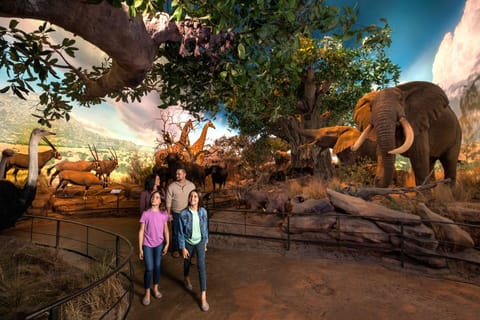
Springfield: Wonders of Wildlife National Museum & Aquarium
Explore the wonders of wildlife at this national museum and aquarium.
Insider tip Wear comfortable shoes for the extensive indoor and outdoor trails.
More to Explore
Even more of the best of Springfield
Lincoln Home National Historic Site
Historic SitesThe two-story Greek Revival frame house at the corner of Eighth and Jackson is the most significant domestic structure in Springfield and one of the most carefully preserved historic homes in the United States. National Park Service rangers lead timed tours through rooms where the floorboards have been worn smooth by a century and a half of respectful footsteps, the parlor where Mary Todd received guests, the kitchen where the smell of old wood and plaster still hangs in the still air, the modest bedroom where Lincoln slept before his departure for Washington in February 1861. The surrounding four-block neighborhood has been restored to its 1860s appearance, with brick paths and no telephone poles, so that the walk from the Visitor Center to the front door feels like a genuine passage through time.
Lincoln Home National Historic Site Visitor Center
Historic SitesThe Visitor Center anchors the southern edge of the historic neighborhood and is the essential first stop for any visit to the Lincoln Home. An orientation film, rotating documentary exhibitions on Lincoln's Springfield years, and the free timed-entry passes for house tours are all distributed here, and the Park Service rangers on duty are among the most knowledgeable Lincoln scholars working in public history, able to field detailed questions about 1850s Illinois law practice, Springfield's social geography, or the political calculations behind Lincoln's 1858 Senate campaign. The bookshop inside carries serious Lincoln scholarship and primary-source reprints unavailable at most commercial booksellers.
Old State Capitol State Historic Site
Historic SitesThe Greek Revival limestone building that served as Illinois's capitol from 1837 to 1876 dominates the old downtown square with a quiet permanence, its white columns cool to the touch even in August. Lincoln argued cases in the courtrooms here, delivered his "House Divided" speech on the senate floor in 1858, and lay in state in the rotunda after his assassination. The restored interior, gas-lamp sconces casting amber light across wooden gallery benches that creak under visitors' weight, the smell of aged timber and cold stone, is one of the best-preserved antebellum legislative chambers in the country, and the building's location at the geographic center of historic Springfield makes it a natural orienting landmark for the surrounding sites.
Dana-Thomas House State Historic Site
Historic SitesFrank Lloyd Wright designed this Prairie Style commission for socialite Susan Lawrence Dana in 1902, and the Springfield house remains one of the finest and most intact examples of his early organic architecture anywhere. The interior develops as a sequence of controlled surprises: ceilings drop low in the entry gallery, then soar in the dining room; 250 amber and green art-glass windows filter afternoon light into shifting patterns of gold and rust on white plaster walls. The smell of aged oak and linseed oil drifts through all 35 rooms. Wright designed more than 100 pieces of custom furniture specifically for the house, most of which remain in place.
Illinois State Museum
Museums and GalleriesThe Illinois State Museum occupies a 1923 Beaux-Arts building near the current State Capitol and holds collections spanning roughly 500 million years of the state's natural and cultural history. The geology and paleontology galleries display specimens recovered from Illinois quarries and riverbeds, including sea-creature fossils from an era when the prairie sat beneath a warm shallow ocean, alongside mastodon bones unearthed from the black soil of central Illinois. The upper floors rotate contemporary Illinois art exhibitions of consistent ambition, and the anthropology collections document Indigenous cultures of the region with particular care. This is a complete natural history and fine arts institution available entirely free.
Air Combat Museum
Museums and GalleriesSpringfield's Air Combat Museum, near Capital Airport, preserves a collection of restored military aircraft that visitors can approach close enough to feel the riveted aluminum skin of a World War II-era fighter and smell the hydraulic fluid and old metal that clings to the fuselage. The cockpits are small, startlingly so, and seeing them at arm's length communicates the physical reality of aerial combat in a way that photographs never quite manage. Volunteer docents, many of them veterans with firsthand knowledge of military aviation, provide historical context that transforms each aircraft from a static display into a machine with a specific operational history.
Edwards Place Historic Home
Museums and GalleriesThe Springfield Art Association has occupied this 1833 Italianate mansion since 1913, and the combination of intact historic architecture and actively rotating contemporary gallery shows gives Edwards Place Historic Home a vitality that purely preservation-focused historic houses rarely achieve. The period rooms downstairs retain their 19th-century furnishings, carved walnut sideboards, horsehair parlor chairs, the particular cool stillness of rooms maintained for preservation rather than daily use, while the gallery spaces upstairs rotate exhibitions of regional and national contemporary artists. The property grounds host outdoor art events during warmer months, turning the tree-shaded lawn into an informal public gathering space.
Springfield and Central Illinois African American History Museum
Museums and GalleriesThis focused museum on the east side of downtown documents the African American experience in Springfield and the surrounding region with unflinching attention to the 1908 Springfield Race Riot, a pivotal event of organized racial violence that shocked the nation and directly prompted the founding of the NAACP. The exhibition design is spare and deliberate, photographs, oral history recordings, handwritten documents, and municipal records given space to breathe rather than compete with interpretive graphics. The low-lit galleries create an atmosphere of genuine reflection, and the Springfield and Central Illinois African American History Museum's archival depth, drawing from local newspaper archives and family collections, gives it an authenticity that no traveling exhibition can replicate.
Lincoln Memorial Garden and Nature Center
Natural WondersEight miles of trails wind through the Lincoln Memorial Garden and Nature Center along the wooded southern shore of Lake Springfield, and the design by landscape architect Jens Jensen, completed in the 1930s, uses only native Illinois plant species to reconstruct the prairie and oak savanna landscape that Lincoln would have known as a young man. In spring the trillium blooms white along the trail edges and the air carries wild ginger and damp earth. In autumn the oaks and maples lay down a dry, smoky carpet of leaves that crackle underfoot on the packed-dirt paths. The lake comes into view in openings between the trees, gray-green and wide, with herons standing motionless along the marshy edges.
Washington Park
Natural WondersWashington Park covers roughly 90 acres on the western edge of Springfield's downtown and is anchored by the Carillon, a 132-foot bell tower whose 66 bronze bells send a sound rolling across the park's open lawns that can be heard two miles away on still afternoons. The park has mature oaks and lindens whose canopy creates deep shade in summer, a lagoon where ducks cluster near the stone footbridge, and formal garden beds fragrant with lavender and sweet grass that line the main walking paths. The Carillon recitals, performed on summer afternoons by skilled musicians playing the full range of the instrument, are one of Springfield's singular public pleasures.
Planning Your Visit
Practical tips for getting the most out of Springfield
Explore more experiences in Springfield
Browse live availability and pricing.
Didn't see anything interesting yet?
Browse Viator's full catalog of tours, day trips, food experiences, and private guides in Springfield.
See All Springfield Tours on ViatorReady to plan your trip to Springfield?
Now that you've got the research covered, here's where to go next.